

Frame Carry vs Farmers Carry – Which is Harder?
Frame Carry vs Farmers Carry: Which Strongman Event is Harder?
If you have ever watched The World’s Strongest Man or the Arnold Strongman Classic, you’ve seen the giants of the sport pick up impossibly heavy objects and race down a track. It’s a primal test of speed, grip, and sheer structural integrity. But among the moving events, two disciplines stand out as the titans of torture: the Farmers Carry and the Frame Carry (often called the Timber Carry).
To the uninitiated, they might look similar. You pick up heavy things and you run. But ask any athlete who has stepped onto the course, and they will tell you that these are two entirely different beasts. The debate over Frame Carry vs Farmers Carry is a staple in gyms and forums alike. Is it harder to stabilize two separate weights, or is it harder to manage the awkward geometry of a massive frame?
The answer isn’t a simple “yes” or “no.” It comes down to biomechanics, physics, and the specific limitations of the human body under load. In this breakdown, we look at the science behind the stride and the geometry of the grip to determine which event truly pushes the limits of human strength.
Frame Carry Physics: The ‘Included Angle’ and Structural Load
If you look purely at the numbers on the plates, the Frame Carry often looks heavier. It’s not uncommon to see Frame Carries pushing 400kg (880lbs) or more, while Farmers Carries often sit in the 300kg–350kg (total) range. You might assume the Frame is harder just because it’s heavier, but the difficulty of the Frame Carry is actually rooted in geometry, specifically something called the “included angle.”
When you pick up Farmers Walk handles, gravity does most of the aligning for you. The weights hang vertically from your hands, directly beneath your shoulders. The line of force is straight down.
The Frame Carry changes the game. Because the frame is a rigid, rectangular structure, the handles are fixed at a specific width. For many athletes—especially those who aren’t built like refrigerators—this width is wider than their shoulder width. When they pick it up, their arms are forced outward at an angle rather than hanging straight down.
This creates a triangular geometry with the athlete’s body. Physics dictates that this “included angle” amplifies the total load experienced by the arms and upper back. Research suggests that for shorter athletes or those with narrower shoulders, this angle can amplify the effective load by up to 1.4 times the actual weight. That means a 300kg frame can feel significantly heavier on the connective tissue than 300kg of Farmers handles. You aren’t just holding the weight up; you are fighting the frame’s desire to pull your arms out of their sockets.
Grip Strength Comparison: Deep Grip vs. Frame Width
Ask any strongman where the event is won or lost, and they will point to their hands. Both events are grip-killers, but they attack the hand in fundamentally different ways.
The Farmers Carry handles are usually designed to allow for what is known as a “deep grip.” Because the handles are free-moving and often thinner or situated to allow full rotation, an athlete can wrap their hand further around the bar, locking it deep into the palm. This mechanical advantage allows for better endurance. You can “hook” the weight rather than just squeezing it.
In contrast, the Frame Carry offers no such luxury. The parallel handles of a frame are often thicker and fixed in position. Because the frame forces your arms outward (as mentioned above), it prevents the wrist from curling inward to secure that deep, fleshy lock. You are forced to rely on pure crushing grip strength and fingertip friction.
Unless straps are allowed—which changes the dynamic entirely—the Frame Carry is widely considered the superior test of raw, static hand strength. It strips away the technique of the “hook” and leaves only the brute force of the squeeze.
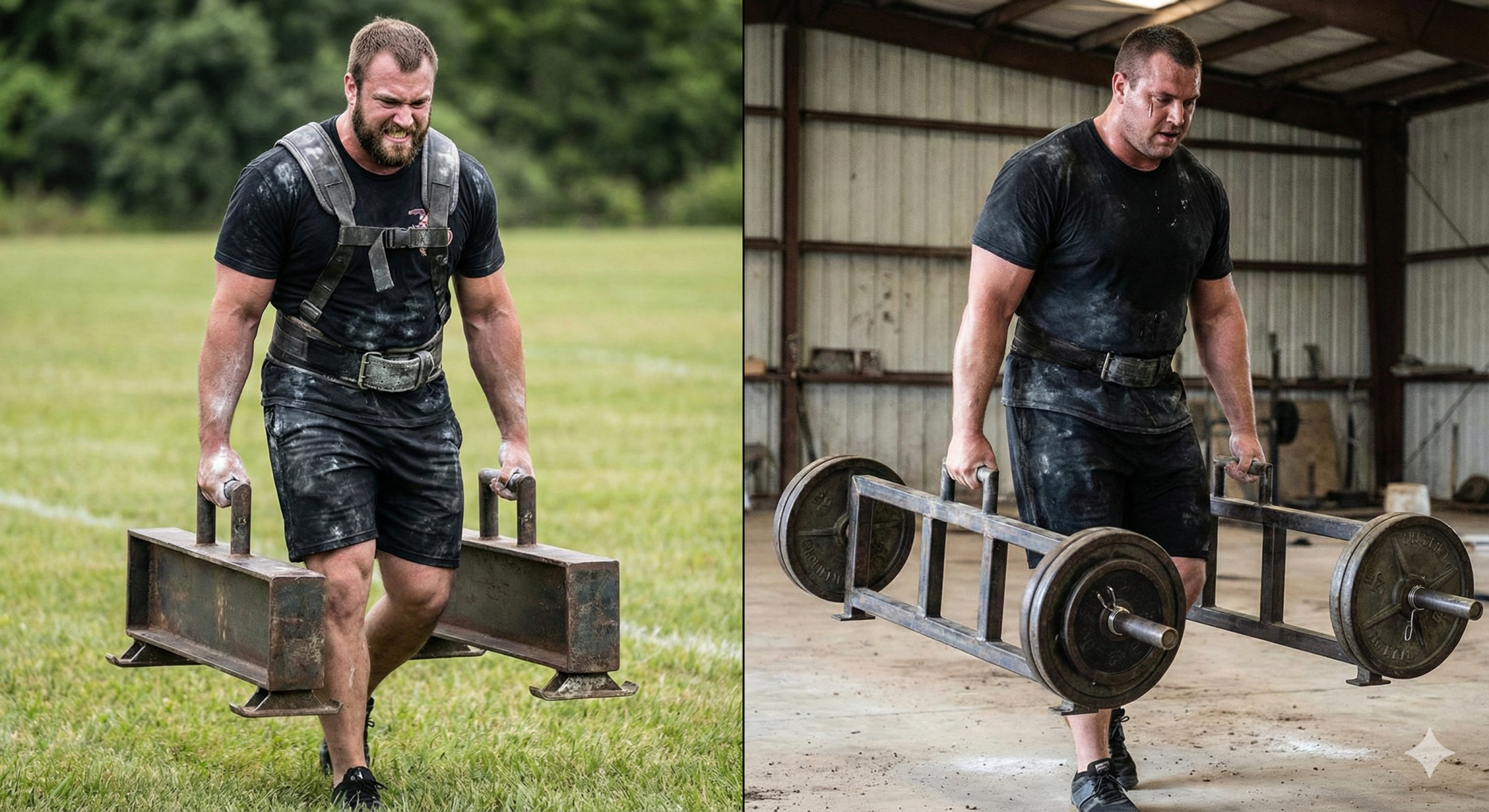
Stability Challenges: Farmers Walk Balance vs. Frame Carry Pitch
If the Frame Carry wins on brute mechanics, the Farmers Carry wins on chaos.
The defining characteristic of the Farmers Walk is independence. You are carrying two separate implements, one in each hand. They are not connected. This means they can swing forward, backward, and crucially, side-to-side (medial-lateral).
When you run with Farmers handles, you are fighting a constant battle against asymmetry. If your left step is slightly more explosive than your right, the left handle swings. If you lose focus, the handles can crash into your legs or drift away from your center of gravity, pulling you off course. This requires intense individual limb coordination and stabilizer activation.
The Frame Carry moves as a single unit. It eliminates the lateral, independent swing. The left side cannot drift away from the right side. However, this creates a different stability monster: Pitch Instability.
Because Frame Carry implements are essentially long rectangles (sometimes nearly double the length of Farmers handles), they are prone to tipping forward and backward. If an athlete accelerates too hard, the “nose” of the frame dips. If it dips too low, it hits the floor, acting as an instant brake. While you don’t have to worry about the weights hitting your shins sideways, you have to possess immense wrist control to keep the massive apparatus perfectly level while sprinting.
Biomechanics of Loaded Carries: Stride Rate and Force Production
Walking with 300kg+ in your hands is not the same as walking to the bus stop. It is effectively a weighted sprint that alters human gait mechanics entirely.
Biomechanical analysis of loaded carries shows that to manage these massive loads, athletes instinctively alter their stride. The goal is to maximize propulsive force while minimizing the time spent on one leg (which is a moment of instability).
- Stride Rate: Strongman athletes utilize a stride rate significantly higher than unloaded walking (approx. 1.42 Hz). Quick feet are essential.
- Stride Length: The stride length decreases by roughly 30%. Taking long strides increases the vertical oscillation (bouncing) of the weight.
The Farmers Walk specifically generates massive vertical and anterior-propulsive forces. Because the weights are unstable, the body must also produce significant medial-lateral forces to stop the weights from banging together. This is why you see athletes taking short, choppy, rapid-fire steps (“duck walking”) rather than long, bounding strides. The biomechanical goal is to keep the center of mass smooth and level to prevent the physics of the swinging weights from taking over.
Strongman Equipment Guide: Handle Length and Pickup Mechanics
The “pick” (the initial lift off the ground) sets the tone for the run.
In a Farmers Carry, the pick is generally straightforward, though the independent nature of the handles means you have to balance them immediately. However, the Frame Carry pick can be technically more demanding due to the handle height and length.
If the “nose” of the frame is resting on the ground, the athlete has to deadlift the weight while ensuring it rises evenly. If the back comes up first, the front drags. If the front comes up first, you lose momentum.
Furthermore, the handle length amplifies the “tipping” movement mentioned earlier. A small twitch of the wrist results in a large movement at the end of a long frame. This makes the equipment itself a lever working against the athlete. It’s not just about lifting the weight; it’s about controlling a 10-foot long lever arm with your wrists while your legs are burning with lactic acid.
World Records: Frame Carry vs Farmers Walk Elite Standards
To understand the difference in difficulty, we can look at the numbers put up by the best in the world.
Generally, absolute numbers are higher on the Frame Carry. For example, British strongman legend Terry Hollands holds a Frame Carry world record of 340kg over 40 meters. In contrast, his raw grip Farmers Walk world record is 150kg in each hand (300kg total) for the same distance.
Why the discrepancy? It often comes down to straps and friction. Frame Carries (like the Timber Carry at the Arnold) sometimes allow lifting straps. When straps are involved, the grip factor is removed, and the athlete can move truly gargantuan weights—sometimes exceeding 400kg or even 500kg.
However, when comparing raw grip to raw grip, the numbers get closer, but the Frame usually stays heavier simply because the single-unit structure is easier to balance than two wild, swinging Farmers handles. The Farmers Carry tests the limits of coordination and raw grip at a lower absolute weight, while the Frame Carry tests total body structural capacity at a higher absolute weight.
Training for Carries: Speed, Straps, and Technique Tips
Training for these events requires a full-body approach. Both exercises hammer the upper traps, glutes, hamstrings, and core. But there are nuances.
For the Farmers Carry: You must train your Quadratus Lumborum (QL) and obliques. These muscles support the pelvis and spine against the shear forces of independent heavy loads. If your core is soft, the handles will pull you apart. Training focuses on unilateral stability and grip endurance.
For the Frame Carry: The focus shifts to upper back width and pure crushing power. Because of the “included angle,” your lats and rhomboids take a beating trying to keep your arms from flaring out. Training often involves “dead starts” to practice the pick and short sprints to manage the pitch of the frame.
The Strap Question: In competition, the Farmers Carry is almost exclusively performed raw (no straps). It is the gold standard for grip strength. The Frame Carry varies. If you are training for a competition that allows straps, the event becomes a test of speed and hamstring power. If you are training for a raw Frame Carry, you must prioritize short, heavy holds to build the crushing strength required to fight the wide handles.
5 Key Takeaways
- The “Included Angle” Difficulty: The Frame Carry is mechanically harder for the arms because the wide frame creates an angle that amplifies the load (up to 1.4x) compared to the vertical hang of Farmers handles.
- Grip Mechanics: Farmers handles allow for a “deep grip” (better endurance), while the wide parallel handles of a Frame Carry force athletes to rely on weaker fingertip/crushing strength.
- Stability Profiles: Farmers Carries are unstable laterally (weights swinging side-to-side), requiring limb coordination. Frame Carries are unstable vertically (pitching forward/backward), requiring wrist control.
- Stride Technique: Both events require a weighted sprint technique: high stride rate (fast feet) and short stride length to minimize bounce and manage massive biomechanical forces.
- Elite Standards: Athletes can generally carry more weight on a Frame (due to structural stability and occasional strap use), but the Farmers Carry is the ultimate test of raw grip and independent limb balance.
Frequently Asked Questions
Why does the Frame Carry feel heavier than the Farmers Carry even at the same weight? The Frame Carry feels heavier due to the ‘included angle’ created by the wider stance of the handles relative to the body. This geometry amplifies the force on the arms, whereas the Farmers Carry keeps the weight directly below the shoulders.
Which event is harder on the grip? Without straps, the Frame Carry is generally harder on the grip because the handle width prevents a ‘deep grip’, forcing the athlete to rely on fingertip strength. However, the Farmers Carry challenges the grip dynamically as the independent weights sway and rotate.
Do athletes use straps for these events? It varies by competition. The Farmers Carry is almost exclusively performed with a raw grip. The Frame Carry (e.g., the Timber Carry at the Arnold Strongman Classic) sometimes permits straps, allowing for much heavier loads (up to 500 kg), though some years it is contested raw.
How does stride technique differ between the carries? Both require short, quick steps to maintain balance. The Farmers Walk specifically sees a 48% to 61% increase in stride rate and a roughly 30% decrease in stride length compared to unloaded walking to maximise propulsive force and minimise braking forces.
What is the main stability challenge in the Farmers Carry? The primary challenge is stabilizing two separate heavy objects. Any shift in balance or asymmetry can cause the implements to swing into the legs or pull the athlete off course, requiring substantial core and unilateral hip strength.
Does the length of the implement matter? Yes. Frame Carry implements can be nearly double the length of standard Farmers handles. This length amplifies any tipping movement; if the ‘nose’ of the frame dips, it hits the ground, making wrist control essential to keep the frame level.
What muscles are primarily worked in these carries? Both exercises work the entire body, specifically the grip, upper traps, core, glutes, and hamstrings. The Farmers Carry specifically demands high activation of the quadratus lumborum and obliques to support the pelvis and spine against the shear forces of the heavy loads.
Add your first comment to this post