
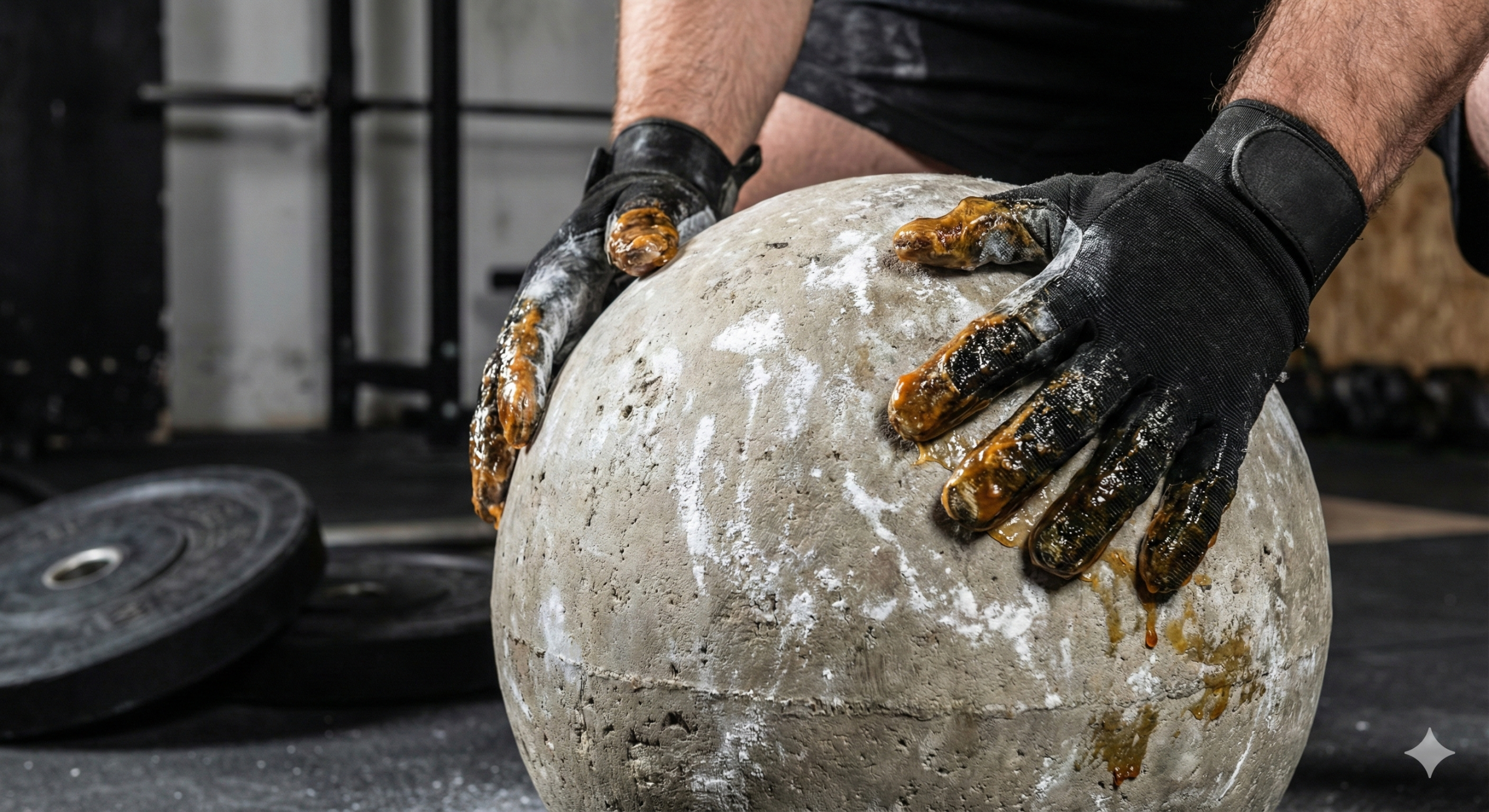
What Tacky to use on Atlas Stones?
If you’ve ever watched a World’s Strongest Man competition and marveled at athletes hoisting 400-pound spherical concrete stones onto high platforms, you might have wondered: “How aren’t those things slipping right out of their hands?”
Atlas Stones are perhaps the most iconic, primal test of strength in Strongman. They are also notoriously difficult to grip. A smooth concrete sphere, combined with sweat and humidity, is a recipe for disaster—unless you have the secret weapon of the trade.
That weapon is tacky.
If you are serious about training Atlas Stones, tacky isn’t an optional accessory; it is essential equipment, much like lifting straps for a heavy deadlift or knee sleeves for squats. Trying to train heavy stones without it isn’t “more hardcore”—it’s just unnecessarily limiting your strength potential and increasing your risk of injury.
But walking into the world of stone lifting adhesives can be confusing. They come in different grades, brands, and consistencies. Choosing the wrong one can leave you with a grip that’s either too slippery or frozen solid. This guide will walk you through everything you need to know to select the right tacky and use it effectively.
5 Key Takeaways for Using Tacky
Before diving deep, here are the five absolute must-know facts about using tacky for Strongman:
- Temperature Blends Are Non-Negotiable: Tacky reacts dramatically to temperature. You cannot use a summer blend in a freezing garage gym and expect it to work.
- Less Is Usually More: A quarter-sized dab is often all you need. Over-applying tacky can actually hinder your performance by “locking” your hands in place too early.
- It’s About Connection, Not Crushing: Experienced coaches use tacky to create a secure connection point on the stone, reducing the need for maximum squeezing pressure, which saves your biceps.
- Conditions Dictate the Product: Professional strongmen often carry multiple blends in their gym bag to adjust for that specific day’s heat and humidity.
- It’s Standard Equipment: Don’t feel guilty for using it. It’s the standard approach for the sport, allowing for heavier lifts and safer technique.
What Is Atlas Stone Tacky and Why Do Strongmen Use It?
At its core, Atlas Stone tacky is a robust adhesive, usually based on pine resin. It’s incredibly thick, sticky, and messy.
Why go through the trouble of coating your arms in tree sap? Because concrete is unforgiving. When you are trying to lappo a max-effort stone, the slightest bit of sweat can cause the stone to slip.
Tacky significantly enhances lifting performance by improving grip contact. But more importantly, it changes how you lift. Without tacky, you have to rely 100% on crushing grip strength to keep the stone from sliding. This puts immense strain on your forearms and, dangerously, your distal biceps tendons.
When you use tacky, the adhesive does much of the work of keeping the stone “stuck” to your forearms and chest. This allows you to focus your energy on the triple extension of your hips and back to get the stone up, rather than just desperately squeezing so it doesn’t fall. It allows for better technique over the course of a training cycle and makes heavier stones accessible.
Choosing the Right Tacky Temperature Blend for Your Climate
This is the single most important factor in buying tacky. Pine resin is highly thermos-sensitive. Its viscosity changes drastically based on the ambient temperature.
If you use the wrong blend, you will have a bad time.
- Using a Warm Weather blend in the Cold: The tacky will turn into a solid rock. It won’t spread on your hands, it won’t stick to the stone, and it will feel useless.
- Using a Cold Weather blend in the Heat: The tacky will turn into watery soup. It will provide almost no friction and will just smear around the stone, making a massive mess without helping your lift.
Most manufacturers provide three general temperature grades. You need to know the rough temperature of where you will be training—not the temperature outside, but the temperature inside the gym where the stone and the tacky jar are sitting.
- Cold Weather Blends (Generally 5°C / 40°F and below): These are formulated to remain pliable even in freezing garage gyms. They are looser and easier to manipulate when cold.
- Cool/Standard Weather Blends (Generally 6-12°C / 42-55°F): The middle ground. This is often the “autumn” or “spring” blend suitable for mild days.
- Warm/Summer Weather Blends (Generally 13°C / 55°F and above): These are very stiff and tough in the jar. They require heat (from your hands and the air) to become usable. In hot weather, they soften up just enough to provide maximum grip without getting runny.
Professional athletes like Mitchell Hooper will often check the gym thermostat before deciding which jar to open. If you are training in a climate-controlled commercial gym, a standard blend might work year-round. If you train in an unheated barn, you will absolutely need a cold-weather blend for winter and a summer blend for July.
Best Atlas Stone Tacky Brands: Cerberus, Strength Shop & More
There are several reputable brands in the Strongman space producing high-quality tacky. Because shipping heavy jars of resin internationally is expensive, your choice might depend on where you live.
- Cerberus Strength: A massive player in the Strongman game, they offer a very clear grading system with multiple temperature options (Grade I, II, III, etc.) making it easy to select the right one.
- Strength Shop: Another major European supplier that offers reliable standard, autumn, and summer blends that are widely used in competitions.
- elitefts: A go-to for North American lifters, their tacky is well-regarded for consistency.
- BTB (Big Tony’s Blend) Sticky Beast: Highly popular in the UK strongman scene, known for having very specific temperature-rated blends.
- NTGear and Beast: Other solid options frequently used by competitors across Europe.
There isn’t necessarily one “best” brand. Many top-tier pro strongmen actually mix brands or carry pots from different companies because they prefer Cerberus’s cold blend but Strength Shop’s hot blend, for example. Your best bet is to pick a reputable brand and buy the blend that matches your current season.
How to Apply Tacky on Atlas Stones for Maximum Grip
Applying tacky is an art form. Doing it wrong can mess up your lift just as much as not using it at all.
Step 1: The Amount
Start small. A common rookie mistake is slathering tacky all over like peanut butter. You generally only need a dab about the size of a quarter (or a 2 Euro coin) for your hands.
Step 2: The Warm-Up
You cannot just scoop it out and immediately grab a stone. You have to work the tacky. Take that quarter-sized dab and rub it vigorously between your palms for a few moments. The friction will heat the resin, making it pliable, sticky, and ready to adhere to the stone.
Step 3: Placement
Apply the warmed tacky primarily to your palms and fingers. Depending on your technique and the size of the stone, many athletes also apply a small amount to the forearms where the stone sits during the lap, and sometimes even a patch on the chest to help secure the stone at the top of the load.
BONUS! Read about Atlas Sleeves!
Common Mistakes Athletes Make With Tacky
- Mistake #1: Using Too Much. If you use too much tacky, it can be counterproductive. Extremely thick tacky can “lock” your hands onto the stone instantly upon contact. If you didn’t get your hand placement perfect on the first try, you won’t be able to slide your hands into a better position because you are stuck fast.
- Mistake #2: Relying Only on the Squeeze. Novices use tacky to squeeze the life out of the stone. Experienced lifters like Nick Best use tacky to create friction points. They let the tackiness do the holding so they don’t have to max-contract their biceps, reducing arm pain and injury risk.
- Mistake #3: Ignoring the Elements. Failing to adjust to the weather is the biggest error. If you bring your summer tacky to a contest on a surprisingly cold rainy day, you will fail your lifts. Always have a backup plan for temperature changes.
How to Remove Tacky from Skin and Stones
The lifting is fun; the cleanup is awful. Tacky does not come off with soap and water; it just laughs at soap. You need something that breaks down resin.
Cleaning Your Skin: You need an oil-based solvent. Baby oil is very effective and relatively gentle on the skin. Other popular options include vegetable oil (cheap and easy), citrus-based cleaners (like Goo Gone, but can be harsh on sensitive skin), or even WD-40 in a pinch (though perhaps not great for daily use on skin). Apply the oil liberally, rub your hands together until the tacky dissolves into a sludge, and then wash with soap and hot water.
Cleaning the Stones: If you own your own stones, you’ll eventually need to clean the buildup off them. Read our guide on cleaning atlas stones!
Tacky Rules in Strongman Competitions
In almost every sanctioned Strongman competition involving Atlas Stones, tacky is permitted. It is the standard.
However, there are exceptions. Some competitions might specify “tacky towels only.” A tacky towel is a rag soaked in a lighter resin solution. It provides some tackiness without the messy, thick paste of traditional tacky. It’s less effective for max weight but cleaner.
Furthermore, there is a major etiquette rule regarding tacky: Never use it on natural stones. If you are lifting historic stones in Scotland or Iceland, tacky is strictly forbidden. It ruins the porous surface of natural rocks and is considered disrespectful to the tradition. Tacky is for concrete Atlas Stones only.
Frequently Asked Questions (FAQ)
How much tacky should I use? Start with a quarter-sized dab on your palms. Warm it up by rubbing your hands together vigorously. You can add small amounts to your forearms if needed for heavier stones, but more is not always better.
What’s the difference between tacky and grip spray? Tacky is a thick pine resin paste providing intense grip for heavy loads. Grip spray is much lighter and less sticky, usually insufficient for heavy stones. “Tacky towels” offer a middle ground—less messy than paste, but stickier than spray.
Which tacky brand is best? Top brands include Cerberus Strength, Strength Shop, elitefts, BTB Sticky Beast, Beast, and NTGear. The “best” brand is less important than choosing the correct temperature grade tailored to your training environment.
Can I use the same tacky year-round? No. Temperature drastically affects performance. You will likely need at least two grades: a cold-weather blend for winter (keeps it pliable in the cold) and a warm-weather blend for summer (stops it from melting into soup in the heat).
How do I remove tacky after training? For skin, use baby oil, vegetable oil, or WD-40 to break down the resin, then wash with soap. For stones, use a plastic scraper (never metal) to remove the bulk, followed by a degreaser.
Will tacky damage my Atlas Stones? No. Tacky does not harm concrete stones. It will build up over time, but it is a temporary surface treatment that can be cleaned off without damaging the concrete beneath.
Are there any safety concerns or allergies? Tacky is generally safe, but it is made from pine resin. If you have a pine allergy, you should avoid it. Avoid getting it in your eyes, and check ingredients if you have highly sensitive skin.
Add your first comment to this post